
Yash Jhaveri
Software Engineer @ Oracle
About
I am currently exploring opportunities to contribute and build the next era of systems, agents and infrastructure.As a Software Engineer, I am always building and engineering systems. My interests lie in building at the intersection of Infrastructure and Distributed and AI Systems, particularly in how large-scale systems are architected, scaled, and evolved in the real world. I enjoy breaking down complex problems, reasoning about trade-offs, and building systems that are both resilient and extensible.At Oracle, I was part of the Edge Cloud Platform team, where I work on Oracle Kubernetes Engine (OKE), Serviceability, and foundational Layer-1 services that power reliable, scalable cloud infrastructure. Previously, I have worked on building the Cost Engineering Platform at Tesla as a Full-Stack Developer and have worked on building ML/AI systems, architecting data pipelines, and building products from the ground up.With the pace of innovation in this space, I’m constantly experimenting, building and iterating. I enjoy collaborating on projects, deep system design discussions, and exchanging ideas on the future of cloud-native platforms and AI-driven systems and infrastructure.Always happy to connect for a coffee chat, brainstorm ideas, or collaborate on something meaningful.
United States
San Francisco Bay Area
Computer Software
Distributed Systems, Python (Programming Language), AI Infrastructure, Kubernetes, Artificial Intelligence (AI), Software Infrastructure, Go (Programming Language), Security, Networking, Container Orchestration, Containerization, Grafana, Prometheus, Loki, Full-Stack Development, Database Systems, Amazon Web Services (AWS), Generative AI Tools, Ollama, Pandas (Software)
Experience

Software Engineer
Oracle

Redwood City, California, United States
Building and scaling the Platform layer for Oracle Edge Cloud, including OCI Private Cloud Appliance (PCA), Cloud@Customer, and Roving Edge. Working across Oracle Kubernetes Engine (OKE), FedRAMP-compliant environments, Layer 1 services, and Observability platforms to deliver secure, reliable, and highly available cloud infrastructure.

Software Developer
Tesla
Fremont, CA
Cost Engineering Automation - building tools to help engineers and SCMs to better coordinate and drive down part costs • Architected a cross-functional automation engine for part-sourcing workflows, collaborating with supply chain and product teams to deliver a scalable, adaptive system capable of handling dynamic operational requirements and enabling data-driven decision-making • Engineered an AI inference pipelines for geometric feature extraction, integrating Transformers with vectorized operations and optimized graph algorithms, reducing latency by 75% for large-scale spatial datasets and laying the groundwork for AI-powered component analysis • Streamlined engineering velocity by designing robust CI/CD pipelines with Docker and GitHub Actions, automating multi-stage containerized builds for distributed workloads

Generative AI Research Assistant
USC Marshall School of Business
Advisor: Prof. Angela Zhou • Developed infrastructure on USC Cloud to run local LLM models and pipelines for confidential social datasets and leveraging causal inference to label data subject to budget constraints • Architected a scalable backend system to process NYC homelessness survey data, using multi-agent workflows to assess housing eligibility • Designed a fault-tolerant ML inference batching service with rate limiting, retry mechanisms, and resumable workflows, supporting large-scale LLM workloads and reducing inference API calls by 85% • Implemented LLM pipelines with recency-weighted summarization and cached batch contexts, improving contextual accuracy and results

Software Developer Intern
Zymo Research Corp
Orange County, California, United States
At Zymo Research, I contributed to the bioinformatics team, focusing on enhancing the Aladdin platform, a web-based tool for analyzing Next-Generation Sequencing (NGS) data through bioinformatics pipelines. Try out the Chatbot the Aladdin Staging Website: https://staging.aladdin101.org/pipelines The other chatbot requires Login Access. Objective: Aladdin aids users to process their NGS reports and generated detailed reports. However, users often need additional guidance in: 1. Pipeline Recommendation: Choosing the optimal pipeline or library type for their dataset. 2. Report Analysis: Requesting detailed analysis of specific report sections and additional information on data relevance and visualizations not included in the initial report. Key Contributions: 1. RAG Chatbot Microservice: I developed a chatbot using LLMs, Langchain, and Pinecone, addressing user needs more effectively. This reduced support requests by 85% and greatly improved user experience. 2. Django API Optimization: I reduced API processing time from 2 minutes to 16 seconds through parallel execution and bulk inserts. This optimization boosted system throughput by 75%, making the platform faster and more efficient. 3. Modular Next.js Chat Component: I created a reusable Next.js component for the chatbot’s frontend, cutting code redundancy and reducing integration time by 40%. Problem Solved: I built chatbots to recommend suitable data pipelines and assist with report analysis. My work in advanced question and report parsing led to significantly improved response accuracy and relevance. Additionally, I optimized APIs to reduce processing time and developed a modular Next.js component that enhanced code reusability and streamlined integration efforts. Learnings: This experience enhanced my skills in RAG application development, system optimization, AWS data pipelining, and bioinformatics. Visit the Aladdin Staging Website: staging.aladdin101.org (chatbots will be deployed soon).

Machine Learning Intern
USC Information Sciences Institute
Los Angeles, California, United States
At USC Information Sciences Institute (ISI), I had the privilege of working in the AI4Healthcare department under the guidance of Prof. Michael Pazzani and Prof. Rostami. My focus was on developing advanced deep learning systems to tackle the critical challenge of glaucoma detection, a time-sensitive issue in healthcare. Challenge: Early detection of glaucoma is vital but challenging due to the complexity involved in analyzing medical images. The dataset used for this task was highly imbalanced, making accurate image classification difficult. Key Contributions: 1. Enhancing Model Performance: I achieved a 30% increase in accuracy and ROC-AUC scores by adjusting class weights and employing data augmentation techniques. This was crucial in addressing the data imbalance within the glaucoma detection dataset. 2. Improving Model Transparency: To ensure the reliability of model predictions, I used Explainable AI (XAI) tools like Captum to highlight important areas in the images. I further verified these by calculating Jaccard Similarity and Dice Score, comparing human-annotated images with model predictions. 3. Conducting Research: My research contributed to the development of advanced deep learning models for imbalanced image classification, specifically focusing on glaucoma detection. I used XAI techniques like Lime, XRAI, Integrated Gradients, Saliency Maps, and Grad-CAM to enhance model explainability and reliability. Impact: The work I did has the potential to help doctors speed up the glaucoma detection process, which traditionally takes a lot of time. This can lead to better outcomes for patients by catching the disease earlier Learnings: This experience enriched my expertise in Explainable AI (XAI), advanced Convolutional Neural Networks (CNNs), and the application of AI in healthcare. I am currently collaborating with expert doctors and professors Michael Pazzani and Rostami to draft a research paper on these findings.

Machine Learning Developer Intern
Indian Institute of Technology, Patna
During my internship at IIT Patna under Dr. Raju Halder, I collaborated with Ph.D. students on a fintech project to enhance cryptocurrency network security using advanced machine learning techniques, targeting widespread phishing activities in decentralized finance. Problem: Cryptocurrency networks are prone to sophisticated phishing attacks due to their complex graph structures, requiring innovative solutions for effective detection. My Role: 1. Research in Graph Theory: I explored advanced graph theory concepts and implemented baseline algorithms like Node2Vec and SIGTRAN to benchmark performance and understand cryptocurrency network dynamics. 2. AI Model Development: Using PyTorch, I developed a phisher detection system with graph neural networks (GNNs), incorporating temporal graph and time series analysis to identify phishing patterns. 3. Collaborative Model Optimization: I collaborated with Ph.D. students to optimize AI models, focusing on advanced feature generation and fine-tuning GNN architectures to improve phishing detection in dynamic networks. Key Achievements: 1. High-Impact Model Development: I led the creation of a GNN model that outperformed 80% of existing methods, demonstrating my ability to handle and interpret complex graph-based data effectively. 2. Leadership and Collaboration: I showcased leadership and teamwork by coordinating with diverse researchers, contributing to a project that significantly improved security measures in financial technology. Learnings: This experience greatly enhanced my expertise in AI and graph theory, especially in applying these skills to real-world fintech challenges. It highlighted my ability to innovate and implement sophisticated solutions in high-pressure environments, preparing me for future roles in data science and AI within the financial technology sector. Contributed to Paper: https://www.sciencedirect.com/science/article/pii/S2096720923000283
Data Engineering Intern
Think360.ai
Mumbai, Maharashtra, India
At Think360.ai, I played a pivotal role in tackling a critical issue in the Indian financial sector—developing a credit score predictor for individuals without credit cards. This initiative was aimed at preventing the exploitation that occurs when people, denied fair loan terms, resort to borrowing from richer individuals who charge exorbitant interest rates, leading to financial misery and, in some cases, even loss of life. Problem: In India, many people lack credit cards, making it challenging to assess their creditworthiness. This often results in high interest rates or loan denial, forcing individuals to seek loans from unscrupulous lenders, leading to severe financial consequences. To address this, Think360.ai partnered with Indian banks to collect and analyze user transaction data from debit/credit messages, with the goal of building a predictive model for credit scores. My Role: 1. Implemented a Comprehensive ETL Pipeline: Automated the data cleaning and processing phase using PySpark, enabling the finance team to generate analysis and reports 3x faster. 2. Analyzed Financial Data: Applied statistical and graphical techniques to identify patterns and enhance the predictive model. 3. Engineered an NLP Pipeline: Developed an NLP pipeline using TensorFlow, AWS Sagemaker, and AWS Lambda to streamline the prediction and testing process. 4. Data Warehousing: Utilized Snowflake and AWS S3 for efficient data storage and management. Key Achievements: 1. Led the end-to-end implementation of ETL and ML pipelines, collaborating directly with the team manager to ensure the project’s success. 2. Contributed to the development of a credit score predictor that aims to offer fairer loan terms, reducing the need for individuals to turn to exploitative lenders. Learnings: I gained hands-on experience in ETL pipeline development, NLP model implementation, and large-scale data analysis using advanced tools like PySpark, TensorFlow, and AWS.

Backend Development Intern
Prixled
At Prixled, I had the opportunity to significantly enhance the platform's communication features by building a chat-system and streamline the backend processes. Problem: Prixled sought to improve user engagement and communication efficiency on their website by integrating advanced real-time chat and notification systems. They also faced challenges in API stability and media data handling, which required innovative solutions. My Role: 1. Development of Real-Time Communication Systems: I developed a real-time chat application and notification system, dramatically improving user interaction and responsiveness on the Prixled platform. 2. Initiative in API Testing and Optimization: I spearheaded the creation of a comprehensive unit testing framework for APIs, which identified and rectified non-functional APIs, cutting debugging time by 40%. 3. Custom AWS Integration for Media Processing: On my own initiative, I implemented custom Lambda functions to enhance the processing and storage of media data into AWS S3 Buckets, boosting media handling efficiency by 25%. Key Achievements: 1. Engineered and implemented critical real-time features that enhanced the platform’s functionality and user experience. 2. Developed and introduced an innovative unit testing framework and AWS-based solutions that improved system reliability and performance. Impact: My tenure at Prixled not only honed my skills in backend development and system architecture but also positioned me as a proactive contributor to technological enhancements. My efforts in introducing unit testing and optimizing cloud-based data processing significantly advanced Prixled's backend capabilities, setting a new standard for their technological operations.

Full-Stack Developer Intern
Sapio Analytics
During my internship at Sapio Analytics, I contributed to two significant projects that spanned the public sector and the adtech industry, gaining valuable experience in backend development, database management, and data-driven insights. Project 1: Census Application Development I developed the backend for a state-level census application in India, introducing a multi-tenant database architecture to manage diverse data forms efficiently. This role involved collaborating with high-ranking officials and optimizing API performance through advanced statistical methods and indexing techniques. Project 2: Adtech Analytics Dashboard For the adtech project, I developed an analytics dashboard to analyze demographic data from mall video feeds, enhancing ad sales strategies. I handled live-stream data processing and designed interactive visualizations that drove significant improvements in ad revenue models. My Role: 1. Developed and optimized backend systems for both projects, ensuring efficient data management and retrieval. 2. Introduced and implemented a multi-tenant database architecture, tailored to the specific needs of the census application. 3. Built and optimized APIs, ensuring they were scalable and efficient. 4. Created interactive dashboards and visualizations that provided valuable insights for decision-making. Key Achievements: 1. Implemented custom solutions that enhanced application performance and API efficiency. 2. Optimized database queries, resulting in a notable improvement in API efficiency. 3. Provided actionable insights that notably increased ad revenue. Learnings: Through these projects, I gained hands-on experience in creating efficient backend systems, managing complex data environments, and translating raw data into meaningful insights. I also developed a deeper understanding of the importance of optimizing APIs and databases, and the value of interactive data visualizations in driving business decisions.
Education

University of Southern California
Computer Science
Coursework: CSCI 570: Analysis of Algorithms CSCI 585: Database Systems CSCI 571: Web Technologies CSCI 550: Advanced Data Stores CSCI 544: Applied Natural Language Processing DSCI 552: Machine Learning for Data Science CSCI 566: Deep Learning and It's Applications Research: 1. USC Information Sciences Institute 2. USC Marshall School of Business

Dwarkadas J. Sanghvi College of Engineering
Computer Engineering
Coursework: Data Structures and Algorithms, Advanced Algorithms, Applied Mathematics, Software Engineering, Operating Systems, Distributed Computing, High-Performance Computing, Information Security, Database Management Systems, Big Data, Artificial Intelligence, Machine Learning, Deep Learning, Natural Language Processing

KC College
Science
3rd in College (HSC - Science)
Yash Jhaveri's Contact Information
Phone
Find the Right Leads
Find Verified Contact Data

What LeadContact does well
Find verified emails, phone numbers, and decision-makers with 98% accuracy.

Find Leads
Find the right people by company, role, industry, location, and more.
925M+ professional profiles


Find Emails
Access verified email addresses for your target contacts.
657M+ emails


Find Phone Numbers
Get cross-validated phone data from multiple top sources.
239M+ phone numbers

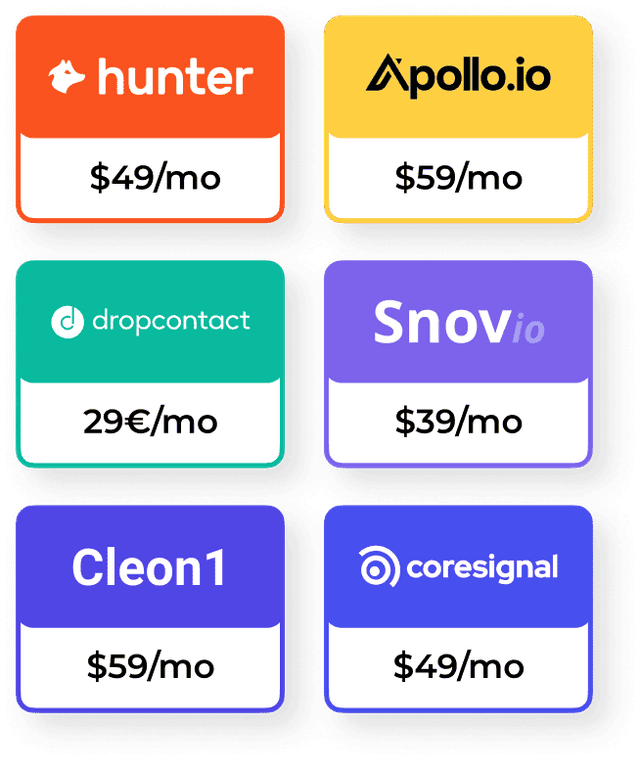
More Accurate. Lower Cost.
Find contact data in 1 tool with 98% accuracy
LeadContact integrates leading enrichment tools to deliver more accurate contact data—without paying for each one.


Great conversations start with the right contact.
It’s time to find yours.