
Khanh Luu
Data Engineer SME @ General Dynamics Information Technology
About
As a data and software engineer with a Computer Science background who has been relentlessly looking for better methodologies and technologies to enable enterprise strategic vision and goals and improve software quality, I have discovered and practiced machine learning with python, distributed parallel computing with HDFS, Apache Spark core (2015), the theory and concepts of Object-Oriented paradigm with its Unified Modeling Language (1994), Business Rules approach (2005), Enterprise Architecture (2008, Zachman framework, FEAF, DODAF, TOGAF), knowledge management in my work environment through work, presentations, and persuasion. I later on advised about multi-cloud strategies and architectures and am on the learning path of next AI advances since machine learning models. Some of the projects that I got involved are: 1. big data (HDFS, Apache Spark, DynamoDB) vs data engineering (ETL with Databricks, NiFi) 2. multi-cloud advocacy program with technical writing, presentation of technical subjects, strategizing on multi-cloud advocacy objectives, embracing cloud native and multi-cloud benefits and mentoring. 3. authentication service with OAuth 2.0 and OpenID Connect client, leveraging Spring Boot and Spring reactive. 4. supporting the vision of machine learning at the organization level 5. serverless architecture with AWS cloud services 6. multi-cloud advisory 7. data engineering projects Past certifications: Sun-certified Java programmer (1998) FEAC-certified Enterprise Architect (2008)
United States
Leesburg
Information Technology & Services
Python (Programming Language), Strategic Thinking, Software Systems, Engineering Leadership, Application Architecture, Government Officials, Technical Direction, Customer Requirements, Communication, Problem Solving, Architecture Analysis, Information Sharing, Knowledge Sharing, Technical Requirements, Technology Architecture, Defining Requirements, Plain English, Briefing, Computer Science, Presentations
Experience
Data Engineer SME
General Dynamics Information Technology

Chantilly, Virginia, United States
As I am on the learning mode to get a Google Data Engineer certification along with Google Gen-AI startup tutorials, this position attracted me because of its requirements to innovate existing technology stack. This would require assessment of current stack, which I was able to get a high-level view through discussions with the current developer lead and DevOps team. Ongoing assessment at a lower code level.

Chief Engineer
SAIC
Function: API Cloud developer (Oct 2024, Jan 2025 - present): I am in an unfamiliar territory with Typescript as programming language and have many times recourse to using LLM tools to understand some Typescript syntax and the Effect library (purely functional) which is being used extensively. Serverless architecture leveraging AWS services such as Lambda, Api Gateway and State Function. Function: Data Engineer (May 2023 - Oct 2024) in a cloud environment with SaaS Databricks and NiFi. ETL work. I produced visual artifacts to complement the existing organization's knowledge base that lacks visual data flows and workflows to describe the ETL processes. DevOps scripting to automate NiFi cluster deployment. O&M. Forensic work to extract architecture, design, business and system rules of a legacy enterprise Java application. During this time, I get interested in Large Language Models with tutorials from cloud service providers (especially Google). Function: Engineering Manager (Aug 2022 - May 2023) Multi-cloud advocacy group: our tasks were to be well-informed of the current services offered by cloud providers and their services costs in order to advise customers migrating their systems to a cloud or to multi-cloud environment in the most cost-effective way. Supported technical writers' group to broadcast organization mission widely via existing enterprise technical spaces. Encouraged team members to take on more responsibilities and to continue enriching and expanding their technical knowledge. Provided high-level and detailed system specifications of an internal documents repository system within a multi-cloud environment. Applied modeling techniques to simplify complex technologies in order to reach to both technical and non-technical audiences. Proposed strategies for the organization to fulfill its responsibilities.
Java Software Developer
General Dynamics Information Technology
Dulles, Virginia, United States
Maintain legacy workflow Java applications : do tier 3 (sometimes tier 2) technical support, analyze and troubleshoot legacy undocumented source code, gather and create architecture and software artifacts based on legacy source code, and store artifacts online (Confluence) to preserve system knowledge.
Technical Lead
General Dynamics Information Technology
Herndon
1. maintain a legacy Java web application which relied on an instance of IBM Maximo. mostly doing software forensic and storing forensic software artifacts in a web knowledge base for eventual rewriting. 2. implement an authentication service with OAuth 2.0 and OpenID Connect protocol for the organization. Java 11, Spring framework 5.x, Spring security, Spring reactive.

Big Data Developer (Python, from on-premises to AWS), Machine Learning Engineer
General Dynamics Information Technology
Herndon, VA
May 2019 - Jan 2021: May 2019 - Jan 2021: Machine Learning engineer After attending a bootcamp in Google data engineering, I move to support the AI/ML vision of an organization (analyzing existing data, identifying Key Intelligence Question, interviewing projects leads, finding external data resources, ...) to research and develop an end-to-end prototype leveraging open source python libraries for data analysis and machine learning. Oct 2017 - May 2019: Big Data Developer Joined a legacy big data project undergoing modernization and migration to the cloud ( Apache Spark for distributive parallel processing, converting Java components to python); development platform: VM Linux CentOS 6.5; CentOS 7; AWS. * attended Google Cloud (Cloud OnBoard) training to compare with Amazon Web Services (Jun 07, 2018) * attended a machine learning conference
Lead Technologist
Booz Allen Hamilton
VA, USA
Joined an R&D project in January 2015 to work with Cloudera Hadoop framework and with Apache Spark. Together with the project architect we realized two goals: 1. increasing the existing slow data ingestion process and 2. implementing a data analytics platform. We exploited Apache Spark parallel computing to improve the data ingestion speed. July 2015, we completed a fully functional two-tier prototype that reduced ingestion time. Mid August 2015, I completed refining a better user interface using PrimeFaces over Java Server Faces 2.x. September 2017, I added a JAX-RS RESTful web service layer, a JavaFX Windows desktop layer, a HBase NoSQL database layer that stored metadata of processed data; a graph model layer was completed. The project grew from a distributed two-tier to multi-layered with different types of user interface. Development environment: VM CentOS 6.5; deployment platform: a small Linux CentOS cluster
Sr. Principal Software Engineer
General Dynamics Information Technology
1. Interim Assistant Program Manager and SOA engineer / tech lead: 1.a. organized weekly internal tech forum. 1.b. Reverse-engineered legacy code by capturing technology stacks, concepts and relations, underlying business rules, underlying architecture. Promoted knowledge sharing and the preservation of knowledge in wiki. 1.c. Fostered team work. Moderated development team to come up with a set of standards operating procedure draft/outline to which the development team will abide to. 1.d. led a big data analytic cloud proof-of-concept project: at Phase I : data ingestion into Accumulo, a NoSQL database that is part of a cloud ecosystem and infrastructure. During this phase, we built a small two-tier web application to retrieve and display data from Accumulo and did the demo to customers. My contribution was the design and implementation of the data ingestion module. By end of Phase I, I negotiated for the team to attend Accumulo Summit on Jun 20, 2014. Phase II, we defined the semantic model of the data stored in Accumulo using protege tool from Stanford, mapped our specific business concepts to COI Standards. Phase III: mapping of our business concepts to our community of interest (COI) data model; I researched on common UCD data model (Unified Cloud Data) and UCD ingestion process and utilities in order to ingest our data model into UCD data store. I used the results of the research as input to an analytic cloud white paper and presentation. 1.e. Cloud white paper and preparation of presentation to customer: researched on Unified Cloud Data data model (UCD) and UCD ingestion process and its utilities in order to ingest data model into UCD data store; used results of research as input to an analytic cloud white paper and presentation for submission to customers. 1.f. Added enhancement to an analytics custom software
Principal Software Engineer
General Dynamics Information Technology
• (01/2013 – 09/2013) System Architect/Developer supporting CTO office; provided system architecture to software projects as-needed; assisted software project teams resolving technical issues; attended Architecture and Engineering Review Board to review IT systems and COTS products; used Wiki to keep organization informed about latest change of direction at the enterprise level; presented fact modeling techniques to take requirements to customer-facing organization members (project managers and system integrators); advocated requirements modeling as part of project artifacts to complement scrum methodology for project management (presentation, requirements training session given to requirements team); used wiki to write about standards and best practices in software development, focusing on continuous integration with Jenkins and Jenkins plugins); advocated agile modeling to complement scrum methodology. • Award: Technology Rising Star at Women of Color STEM conference, October 2012, Dallas, Texas. • (03/2011-01/2013) XML metadata specialist/Developer: designed and implemented an XML-to-JSON parser in JavaScript; designed and implemented with a co-worker a Java conversion application that extracted IBM Lotus Notes records from a Lotus Notes database into DXL (an XML format) and convert them into enterprise-specific XML specifications; some Perl scripting to cleanse mal-transformed data; supported organization in data mapping (maintaining data mapping rules); represented organization in data mapping, metadata standards committees, and in metadata effort at the enterprise level; advocated Wiki as knowledge management tool and used it to share and preserve knowledge about data mapping rules, XML metadata specifications, operations and maintenance solutions and other technical tips
Sr. Systems Engineer/Enterprise Architect
SAIC
• Requirements elicitation and specifications (produced requirements specifications, developed requirements template and process combining Zachman framework, Business Rules approach methodology, and Rational Unified Process) • Solution Architecture (analyzed and produced findings and artifacts of current architecture, briefed senior management) • Enterprise Architecture: worked with components to produce artifacts for next version of business enterprise architecture (DODAF 1.5, 2.0; BPMN, Business Rules approach) • Provided software development (Java, Google Web Toolkit, C#) • Awards: o BTA Extra Mile recognition for having developed requirements process and requirements template o BTA Extra Mile award as a member of the BEA
AHLTA developer analyst
Northrop Grumman Information Systems
joined AHLTA, a one-stop health care application. AHLTA was on maintenance mode. My work was to analyze legacy code (VB6 and VB.NET) and provide fixes and/or minor enhancements. Scrum methodology was applied. Developers and testers were put into small teams. For each team, a tester acted as team lead, so that developers could focus on maintaining code instead of doing administrative scrum reports with management. Outside of work hours, I gathered information about AHLTA architecture and AHLTA functionalities through exploring existing documents and talking with other developers and testers. Redrew AHLTA architecture diagram to use it for code maintenance instead of the official AHLTA architecture which focused on network architecture. Reverse-engineered requirements with an AHLTA use case model. Volunteered to do a brown bag on software modeling and how it would be beneficial to AHLTA maintenance.

Java consultant
Blue Canopy Group, LLC
Blue Canopy Java consultant working at customer site.

architect
Unisys
• lead role on a TSA project, produced software delivery documents, maintain requirements using RequisitePro • Software Developer: for SBInet project (C#) of Homeland Security, designed and implemented a frontier “post office” that listened and parsed underground live streaming sensor data (from the first P28 miles border in Tucson, Arizona), packaged data into formatted XML messages and delivered messages to subscribers. • Software pilot project: For Open-I Project of Custom and Border Protection, analyzed and defined taxonomy of search key words; researched on business intelligence, social network software (InXight and Endeca), unstructured data, web 2.0, geographic information mapping software, semantic web, Ajax libraries; selected DOJO, PHP, Javascript, Wordpress and MySQL to build search web page. Utilized JSON notation to store searched key words in database. • Business Analyst: For Federal Supply System Modernization project of GSA, performed requirements gathering and specifications applying Rational Unified Process methodology and using Rational Software Modeler to model, Requisite Pro to capture requirements, ClearCase/ClearQuest for Change Requests capture. • Business Analyst: in a pilot project testing Unisys Rules modeler and practicing the Business Rules approach; analyzed, extracted, modeled business concepts, rewrote business rules (according to RuleSpeak®) from the Defense Logistics Management System manuals; presented analysis results to requirements analysts and management. • Java Architect: As a member of the software maintenance team of GSA Advantage online order entry application, provided architecture, design, and implementation of Java applications; wrote white paper persuading management and customer to adopt STRUTS framework; produced Java coding standards for the development team; member of the Software Engineering Process Group; gave technology presentations to Unisys local Java SIG; mentored developers on OOA and OOP
Java developer
Anvicom
I joined a team of Anvicom led by Laura Marriott to work on site at MTMC (Military Traffic Management Command) headquarters in Alexandria. The team provided software and hardware maintenance. The main software application we worked on was a client-server intranet web application with Oracle as persistence storage. Developement IDE was JBuilder.
Education

Louisiana State University
Computer Science
Khanh Luu's Contact Information
Phone
Find the Right Leads
Find Verified Contact Data

What LeadContact does well
Find verified emails, phone numbers, and decision-makers with 98% accuracy.

Find Leads
Find the right people by company, role, industry, location, and more.
925M+ professional profiles


Find Emails
Access verified email addresses for your target contacts.
657M+ emails

Find Phone Numbers
Get cross-validated phone data from multiple top sources.
239M+ phone numbers
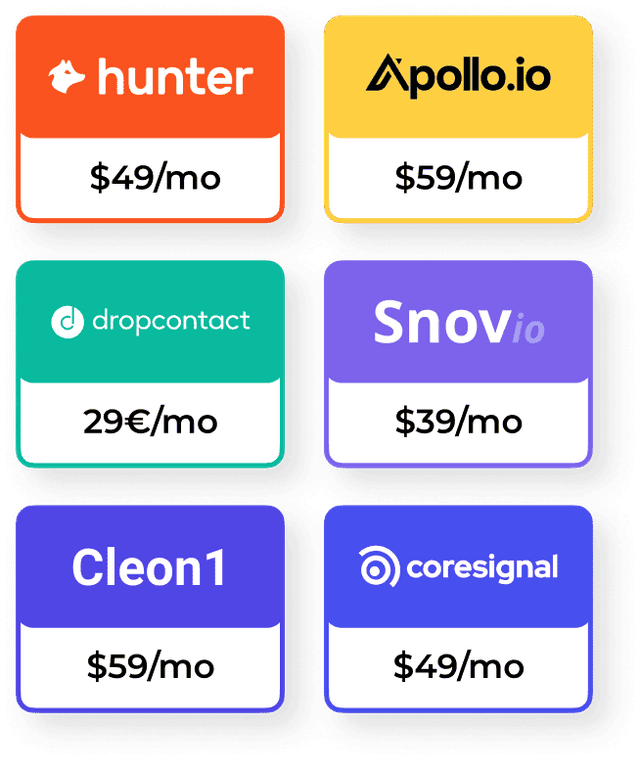
More Accurate. Lower Cost.
Find contact data in 1 tool with 98% accuracy
LeadContact integrates leading enrichment tools to deliver more accurate contact data—without paying for each one.

Great conversations start with the right contact.
It’s time to find yours.