
Ibukun C. Didier
Senior Software Engineer @ Teddy Open Finance
About
As a Senior Software Engineer specializing in Backend and Artificial Intelligence, I design and build robust, scalable, and secure APIs and services using modern, modular, and testable architecture. I am involved in the entire lifecycle, from design to production operations, ensuring quality, security, and predictability. My expertise lies in integrating these backends with AI solutions: I structure context retrieval, orchestrate prompts and evaluations, implement guardrails, and monitor performance for chatbots and automations that address real business challenges. I prioritize clarity in requirements, concise documentation, and data-driven technical decisions. Technologies: * Python | TypeScript | JavaScript | C/C++ * FastAPI | Flask | Streamlit | Node.js | Nest.js | Express * Clean Architecture | Domain-Driven Design (DDD) | Microservices * AWS | Lambda | EC2 | Amazon SQS | AWS SAM | AWS CDK * CI/CD | Docker | Git | GitHub | Jira * IA Generativa | LLMs (OpenAI, LLaMA) | Agentic AI | RAG * LangChain | OpenAI API | MCP * Machine Learning | Deep Learning | Supervised Learning | Unsupervised Learning | Classification | Clustering * TensorFlow | Scikit-learn | OpenCV | MediaPipe * DynamoDB | PostgreSQL | MySQL | MongoDB | Pinecone (vector DB) * Jupyter Notebook | Estatística (descritiva, inferencial, avançada) | Pandas * Data Storytelling | CRISP-DM * HTML5 | CSS | APIs RESTful * Linux | Utalk | Twilio | Robbu I consider myself resilient and results-oriented, striking a balance between planning and execution. My organizational skills and discipline enable me to maintain focus and meet deadlines with quality. I approach tasks with a sense of urgency when necessary, while exercising caution when time allows. I am self-motivated and proactive; when faced with unfamiliar challenges, I actively research, ask questions, and learn quickly. I value frequent and clear communication, practice active listening, and demonstrate empathy, always seeking consensus to minimize misunderstandings and rework. I work diligently with attention to detail without sacrificing speed, effectively managing multiple priorities. I prioritize based on impact and navigate dependencies, ensuring predictability and continuous improvement, all while engaging in respectful and assertive interactions.
Brazil
Boa Vista
Computer Software
Artificial Intelligence (AI), Data Science, Statistics, Scikit-Learn, Seaborn, NumPy, Matplotlib, Anaconda, MOHATAS, K-Nearest Neighbors (KNN), SVC, XGBoost, Random Forest, Ensemble, AWS S3, JSON Web Token (JWT), Computer Vision, OpenCV, Optical Character Recognition (OCR), RTLS
Experience

Senior Software Engineer
Teddy Open Finance

São Paulo, Brasil
Achievements: - Built the company’s first hybrid chatbot, serving ~14k users/day and retaining ~20% of clients via the channel. - Created a rapid “chatbot factory”; delivered an OCR pipeline with multi-layer GenAI for data reconstruction and cross-checks, standardizing records. - Enabled 24/7 access to key financial-service info beyond business hours. Context: At Teddy Open Finance (a Brazilian fintech creating digital solutions for the financial sector, emphasizing customer-service automation, Open Finance, and credit operations), I was responsible for the design and development of hybrid GenAI chatbots, cloud integrations, and process automation. As a Backend Developer focused on AI, I leveraged a strong CS background and expertise in AWS, OpenAI, LangChain, and uTalk to scale these solutions while ensuring security and compliance. Technologies: - AWS (Lambda, S3, Textract, DynamoDB, SQS) - Python (FastAPI, asyncio, Pandas) - LangChain/LangGraph - OpenAI & LLMs - RAG - Guardrails - UTalk | Robbu - Docker - Git - Postgres - Parquet - OpenCV - Microservices - Jira - REST APIs. Activities: - Design & build APIs/microservices (FastAPI + AWS). - Conversational orchestration (LangChain, RAG, OpenAI). - Integrations & sessions: uTalk/WhatsApp, webhooks; session/identity mgmt. - Reliability & delivery: observability (logs/metrics/tracing), CI/CD, ops automation, security hardening; co-define KPIs with Product.

Software Engineer
Senior Sistemas
Blumenau, Santa Catarina, Brazil
Achievements: - Led the critical migration from Google Assistant to a new voice platform (Alexa, Twilio), ensuring use case continuity and enabling hands-free ERP data access. - Increased pilot client inclusion by delivering key accessibility features, including voice reading and GPT-based image descriptions. Context: At Senior Sistemas (a leading Brazilian software company specializing in ERP solutions), I played a crucial role as a researcher and systems developer. I led applied research and prototype design for voice interfaces, integrating Alexa/Twilio assistants to enhance hands-free ERP access for field operations. Collaborating closely with product, security, and customer success teams, I ensured alignment with stakeholder needs and compliance, significantly improving accessibility for pilot clients. Technologies: - Agile / Jira - Alexa - Amazon EC2 - API Gateway - DynamoDB - GitLab - JavaScript - OpenAI - Python - REST APIs - TTS (Text-to-Speech) - Twilio - AWS - AWS Lambda Activities: - Architected the Alexa Skill and Twilio voice flows, defining intents/slots and DynamoDB schemas aligned to ERP data models. - Built serverless APIs (API Gateway + AWS Lambda) to query ERP securely with auth, rate-limits, retries, and structured logging. - Implemented TTS and response templating with OpenAI, adding prompt guardrails and fallback behaviors for resilience. - Designed an accessibility layer for web navigation (keyboard/mouse): focus management, WAI-ARIA/aria-live, and GPT-based image descriptions with on-page reading. - Ran pilot experiments, captured telemetry, and produced adoption playbooks and security/privacy reviews for handoff to product teams.
Software Engineer
Senior Sistemas
Blumenau, Santa Catarina, Brazil
Achievements: - Launched a ChatBot that transformed internal inquiries, measured by a 50% increase in user satisfaction. - Developed a comprehensive Q&A system using LLMs to automate corporate policy and process questions, alleviating support workload and empowering teams. - Established the first reusable GenAI components and evaluation harnesses, enabling new AI features to be prototyped and shipped securely. Context: Development of an LLM-powered virtual assistant to automate internal support and corporate policy Q&A. The project aimed to reduce support team workload and empower employees with instant access to reliable information. Delivered complete RAG architecture, security guardrails, and monitoring dashboards, establishing reusable GenAI components adopted as standard for future AI features. Resulted in 50% increase in user satisfaction. Technologies: - OpenAI - LLaMA - GPT-2/3.5/4 - RAG - Machine learning - JavaScript - Python - Websocket - REST APIs - asyncio - HTML5 - Framework7 - AWS - Amazon AWS - API Gateway - DynamoDB - EC2 - Streamlit - Pandas - Agile Jira - Streamlit Activities: - Built a real-time JS WebSocket + AWS Lambda stack to deliver low-latency chat. - Delivered a GenAI chatbot with RAG and the supporting ingestion/retrieval pipelines. - Authored prompt libraries and guardrails, plus an evaluation harness for quality, safety, and latency. - Shipped HTML5/Framework7 UIs and Streamlit ops dashboards for conversation review and curation. - Instrumented deflection, CSAT, and latency, and established GitLab CI/CD with Product/Security.
Software Engineer
Senior Sistemas
Blumenau, Santa Catarina, Brazil
Achievements: - Developed an indoor monitoring system (RTLS) to track individuals and assets, improving operational visibility and guiding data-driven investment decisions. - Engineered an OCR/ML pipeline for the agriculture sector to capture grain moisture/temperature data, enhancing ERP traceability and compliance. - Validated drowsiness detection using computer vision (MediaPipe/OpenCV) for logistics, strengthening incident prevention and safety compliance. - Automated quantitative data generation for estimators with the "AutoBean" prototype, standardizing spreadsheets and reducing redundant work. Context: At Senior Sistemas, projects focused on computer vision and data automation for operational visibility and safety were delivered. The indoor RTLS monitoring system was designed to track people and assets, aiming to improve operational visibility and guide investment decisions. The OCR/ML pipeline for agriculture captured grain moisture and temperature data for ERP integration, ensuring traceability and compliance. A drowsiness detection system (MediaPipe/OpenCV) for logistics was also validated, focused on incident prevention. Finally, the AutoBean prototype automated quantitative data generation for estimators, standardizing spreadsheets and eliminating redundant work. Technologies: - Machine Learning - MediaPipe - OpenCV - OCR - AWS - Python - REST APIs - GitLab Activities: - Prototyped indoor RTLS for warehouse tracking, set requirements, vetted vendors, and delivered a reference architecture. - Built an Agro OCR/ML pipeline to capture grain moisture/temperature and post normalized ERP records via REST. - Implemented drowsiness detection with MediaPipe/OpenCV using facial landmarks in a real-time loop. - Created AutoBean, a rules pipeline that automates quantity takeoffs, validates sheets, and exports standard outputs. - Finalized datasets, validation, docs, and security/privacy reviews for handoff.

Software Engineer
Instituto de Tecnologias geo-espaciais addressforall
Boa Vista, Roraima, Brazil
Achievements: - Led the refactoring of the "Socialme" codebase, significantly accelerating maintenance cycles and enabling scalable development of new app modules. - Engineered a whitelabel medical module that automated patient record management (with permissions) and streamlined service bureaucracy, reducing overall processing time. - Developed an automated image pipeline that generated all required social media image variations from a single upload, streamlining the content creation process. Context: At Instituto de Tecnologias Geo-Sociais Address Forall (ITGS) (a non-profit association focused on providing open address data for society), I worked as a Backend Developer under an autonomous service contract. I was responsible for the analysis and development of systems and databases across multiple projects, including the "Socialme" startup initiative and the "Alertas Primeira Infância" platform. My core focus was building secure and efficient RESTful APIs for data and file management. Technologies: - Node.js, Express - JavaScript - PostgreSQL (Pg) - AWS (S3) - Docker - JWT - Git - Linux Activities: - Led the refactoring and decoupling of the "Socialme" project's core codebase. - Developed a whitelabel module for medical service processing and patient data management. - Designed and implemented an automated pipeline for social media image processing. - Built and maintained RESTful APIs for secure file treatment and management. - Performed analysis and database development for the "Alertas Primeira Infância" platform.

Research Intern
Embrapa
Boa Vista, Roraima, Brazil
Achievements: - Created the first standardized image database for the Blissus pulchellus and leafhopper pests, defining a new methodology for acquisition, pre-processing, and segmentation. - Validated the feasibility of using Machine Learning for automatic pest classification, addressing the shortage of specialized taxonomists and aiding in the prevention of economic losses in agriculture. - Delivered an end-to-end classification pipeline that achieved 91.77% accuracy (using XGBoost) on the test dataset. - Identified SVC (SVM) as the most robust classifier for generalizing to new, unseen images (validation data), a crucial insight for real-world application. Context: In collaboration with Embrapa - Roraima (the Brazilian Agricultural Research Corporation, a public R&D institution focused on enabling innovation for sustainable tropical agriculture), I conducted my thesis research for the Federal University of Roraima. As a Machine Learning Researcher, I was responsible for the entire project lifecycle: creating a new laboratory image database, building processing pipeline, and rigorously evaluating the feasibility of ML algorithms to solve the real-world problem of pasture degradation in Roraima. Technologies: - Machine learning - Python 3 - Panda - Jupyter - Numpy - Matplotlib - OpenCv - Anaconda - MOHATAS - KNN - SVC - XGboost - Random Forest - Ensemble Activities: - Designed the laboratory image acquisition methodology (magenta background, controlled lighting) to ensure standardization. - Executed image pre-processing (cropping, color normalization) and segmentation (background removal) using OpenCV. - Built the feature extraction pipeline (Haralick texture, Hu Moments shape, color histograms) using OpenCV and Mahotas. - Trained, tuned (hyperparameter tuning), and evaluated model performance (Accuracy, Precision, Recall) on test and validation datasets. - Authored the thesis, documenting the entire research process and the statistical analysis of the results.
Scientific Researcher
Ciência da Computação - UFRR
Boa Vista, Roraima, Brazil
Achievements: - Developed an ML model focused on differentiating intrinsic difficulty (of the question) from perceived difficulty (by the student). - Validated that submission metrics (such as number of attempts, time between submissions, and error types) are robust features for predicting the difficulty level faced by the student. - Automated difficulty classification, providing a tool for instructors to identify common friction points and adapt their teaching. Context: At the Computer Science Department of UFRR (a public institution focused on computing education and research), I served as a Researcher (Undergraduate Research) for the PI3C project. I was responsible for investigating and developing a Machine Learning model for the automatic detection of difficulty levels in programming questions on online judges, focusing on modeling the individual student's difficulty. Technologies: - Python - Pandas & NumPy (for data manipulation) - Scikit-learn (for ML models) - Matplotlib / Seaborn (for visualization) - Jupyter Notebooks (for prototyping and analysis) - NLP (NLTK or spaCy) (for initial text pattern analysis) - Linux Activities: - Dataset collection and structuring from online judge logs (BOCA, URI, etc.). - Feature engineering, extracting submission metrics (e.g., # of attempts, submission time, error logs, code complexity). - Data analysis and labeling to differentiate "question difficulty" (defined by the instructor) from "student difficulty" (inferred from metrics). - Training and validation of classification models (e.g., Random Forest, SVM, Logistic Regression) to predict difficulty levels. - Research documentation and presentation of partial results to the advisor (Prof. Filipe Dwan Pereira).
Education

Universidade Federal de Roraima
Artificial Intelligence
A 480-hour specialization (Lato Sensu) focused on AI for Industry 4.0. The program featured active learning methodologies covering Machine Learning, Deep Learning, data analysis, and the development of AI solutions for industrial process optimization. Emphasis was placed on practical projects applied to production environments and computing research. Key Coursework & Projects: - Machine Learning projects applied to industry - Development of Deep Learning algorithms - Exploratory data analysis (EDA) of industrial data - Research in AI-driven process optimization

Escola DNC
Data Expect
This program was designed to provide comprehensive skill development in Data Science and Machine Learning. The curriculum covered all critical concepts—from data fundamentals to model deployment—and culminated in a practical project solving a real-world business problem. Key competencies and technologies covered: - Data Science methodologies (CRISP-DM) and Agile frameworks (SCRUM) - Python programming for data analysis - Statistics (Descriptive, Inferential, and Advanced) - Database management (SQL and MongoDB) - Data Storytelling - Machine Learning model development - Model Deployment
Universidade Federal de Roraima
Computer Science
Solid foundation with a comprehensive approach to the pillars of computing, focused on software solution development and complex systems analysis. The UFRR program provided a rigorous theoretical and practical foundation, preparing me for technological challenges and for specialization in Artificial Intelligence. Key Areas of Study: - Algorithms and Theory: Data Structures, Graph Theory, Computational Logic, and Optimization. - Software Engineering: Software Lifecycle, Design Patterns, and Agile Methodologies. - Systems and Infrastructure: Computer Networks, Operating Systems, and Database Management (SQL). - Intelligence and Data: Fundamentals of Artificial Intelligence, Compilers, and Data Modeling. Key Competencies Acquired: - Algorithms and Data Structures - Software Engineering - Object-Oriented Programming (OOP) - SQL - Computer Networks - Operating Systems - Algorithm Optimization - Programming Logic - Agile Methodologies
Ibukun C. Didier's Contact Information
Phone
Find the Right Leads
Find Verified Contact Data

What LeadContact does well
Find verified emails, phone numbers, and decision-makers with 98% accuracy.

Find Leads
Find the right people by company, role, industry, location, and more.
925M+ professional profiles


Find Emails
Access verified email addresses for your target contacts.
657M+ emails


Find Phone Numbers
Get cross-validated phone data from multiple top sources.
239M+ phone numbers

More Accurate. Lower Cost.
Find contact data in 1 tool with 98% accuracy
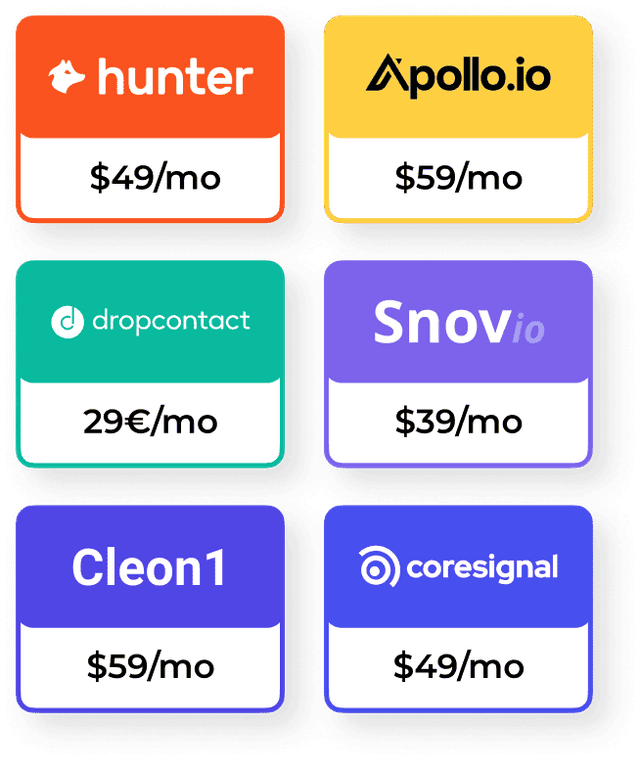
LeadContact integrates leading enrichment tools to deliver more accurate contact data—without paying for each one.


Great conversations start with the right contact.
It’s time to find yours.